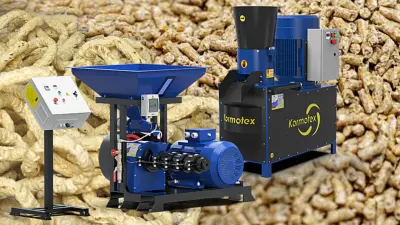
The question of whether to choose an extruder or a pelletizer is not an easy one. Every farmer has their own needs and goals, and the choice of equipment depends on the specific tasks of the farm. Both extruders and pelletizers offer unique advantages and are widely used in animal feed production. Let’s look at the benefits of each device and see what they are best suited for.
Grain Extruder: Features and Benefits
One of the main indicators of livestock efficiency is meat productivity (carcass yield, tissue quality, overall carcass quality). Farmers strive to increase productivity and profit, but some methods, while providing quick results, can negatively affect animal health: metabolism disorders and diseases may occur.
To solve these problems, biologically active supplements, balanced compound feeds, and special grain processing technologies are used. Extrusion is one such technology, allowing for the production of nutritious, safe, and easily digestible feeds.
Extruders appeared relatively recently (about 60 years ago) but have already become indispensable helpers in the production of high-quality animal feed.
The extrusion process takes only 30 seconds. During this time, the grain is compressed by a screw, heated to a high temperature, and subjected to a rapid pressure change — a so-called “explosion” occurs, increasing the volume and changing the structure of the raw material.
Advantages of Extruded Feeds
- Starch is converted into easily digestible sugars during processing.
- The finished feed becomes more nutritious and energy-dense.
- Vitamins and beneficial elements are preserved.
- Extruded feeds have a long shelf life due to low moisture content.
- Thermal treatment destroys harmful bacteria and infections.
Interesting fact: Extrusion increases the biological value of the feed — animals gain weight better and the risk of digestive diseases decreases by 1.5–2 times.
What is feed pelleting?
Pelleting is the process of forming feed into dense pellets of uniform size and composition. Such feed is easier to dose, store, and transport, and animals cannot select individual components, ensuring balanced nutrition.
Due to the high density of pellets, feeding efficiency increases: animals and poultry receive more nutrients per meal.
Advantages of Pelleted Feeds
- Convenient for transportation and storage (do not cake, spoil less with temperature and humidity changes).
- Reliably protected from external factors — sunlight, moisture, mold.
- Balanced composition: each pellet contains the full set of necessary nutrients.
Interesting fact: Pelleted feed is slightly more expensive, but saves money due to minimal losses and long shelf life.
Extruder or pelletizer — which to choose?
Both extruders and pelletizers are great investments for farm development. Extruded feeds are ideal for rapid weight gain and boosting animal immunity, while pelleted feeds are best for efficient, balanced feeding and storage convenience.
On the “TechnoMashStroy” company website, you will find a wide range of extruders and pelletizers. You can choose equipment for any task and production scale. By purchasing modern, high-quality equipment, you increase your farm’s profitability and product quality.
Tip: When choosing a device, consider the type of animals, herd size, available raw materials, your farm’s goals, and automation capabilities. Don’t hesitate to ask for advice — company specialists will help you find the best solution.
Make the right choice — buy a high-performance and energy-efficient extruder or an effective and reliable pelletizer from “TechnoMashStroy” and achieve maximum results for your business!