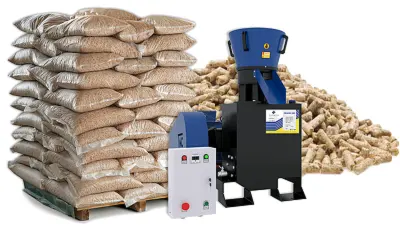
Pellet production in Ukraine: the ideal small business with high profitability
Fuel pellets are highly efficient, eco-friendly biofuel made from woodworking or agricultural waste, with demand growing every year. Setting up your own pellet plant in Ukraine is a great opportunity for small and medium businesses to secure a stable income and contribute to sustainable development and the country's energy independence.
Demand for fuel pellets: current trends
Today, alternative fuel production is one of the most promising business areas in Ukraine. Increasing gas prices, the global energy crisis, government support for renewable energy, and new European environmental standards are driving the development of the biofuel market.
Pellets are ideal for heating private homes, agricultural complexes, industrial sites, power plants, and are also used as animal litter. In addition, fuel pellets are commonly used in solid fuel boilers and gas generator units as a modern alternative to firewood, coal, and even gasoline.
What are fuel pellets and why is their production profitable?
Pellets are cylindrical granules produced by pressing crushed wooden or agricultural residues (sawdust, shavings, straw, sunflower husk, corn stalks). Pellet production not only reduces the volume of waste but also allows additional profit from what was previously considered useless material.
The main advantages of pelletized biofuel:
- High calorific value — 2.5 times more efficient than firewood.
- Low moisture content — guaranteeing better combustion quality.
- Minimal ash content — just 0.75–1.5% compared to traditional wood.
- Eco-friendliness — no toxic emissions.
- Convenient storage, transportation, and precise usage.
Raw materials for pellets: availability and variety
The main factor for a successful pellet business in Ukraine is the availability of cheap raw materials: sawdust, shavings, bark, straw, sunflower husk, dry corn stalks, and other agricultural residues. The agro-industrial sector constantly produces ample raw materials for biofuel production.
Raw material costs are low: for instance, sawdust costs about $5 per cubic meter (based on Ukrainian market data). To produce 1 ton of pellets you need 7.4 cubic meters of sawdust. The cost price of 1 ton consists mainly of raw material and energy expenses.
Pellet production technology: key steps
The manufacturing process includes a clear set of steps:
- Raw material grinding to 4–6 mm (using shredders or straw cutters, such as the SNR-30).
- Drying to an optimal moisture of 10–15%.
- Pelletizing — the feedstock is pressed in a pelletizer (e.g. GRAND-300 or GKM-260) under high pressure and temperature.
- Cooling and packaging for long storage and easy transportation.
Natural lignin acts as a natural glue during the pressing process, ensuring strength and durability. Finished pellets are uniform in size and structure and have a high calorific value.
Pellet production equipment: choice and cost
Investments in equipment return within a few months due to the high business margin. With a wide range of flat and ring-die pellet mills, you can set up anything from a small home mini-factory to a large-scale enterprise for an agro-business or woodworking plant. Popular models such as GKM-260 (up to 150 kg/h) or GRAND-300 (from 300 kg/h) suit different production scales. It's important to consider regular replacement of die and rollers — the main pelletizer parts.
A modern mini-plant complex includes a shredder, dryer, pelletizer, cooler, packaging, and conveyor lines. The price depends on capacity, but even a modest investment allows you to start with a complete process line.
Pellet production economics and profitability
Example calculation: selling 1 ton of pellets on the Ukrainian market starts from $110. Raw material cost (7.4 m³ × $5) is $37. Including operational costs (electricity, wages, maintenance, logistics), profit per ton often exceeds $50. Profit margins can reach 100% or more, and turnover grows with scale.
How and where to sell finished products?
Pellets are in demand from household heating (pellet boilers, fireplaces) to industrial power plants. Automated heating systems in homes and businesses, where pellets are fed by augers from hoppers, are especially popular and ensure continuous and stable operation. In Europe, pellet demand grows each year; in Ukraine, dozens of new factories have opened over the last five years.
Beyond heating, pellets are used as pet litter and as fuel for vehicles with gas generator units. The rise of mobile and mini biofuel power plants brings even more market opportunities.
Advantages of working with equipment manufacturer TechnoMashStroy
TechnoMashStroy manufactures a wide range of pellet mills, straw choppers, conveyors, and other agri-equipment for pellet production. You receive professional support, warranty and after-sales service, expert consultations on start-up and optimization, and certification guidance.
You can order modern equipment today: the company provides turnkey solutions and helps your business reach a new level!
Conclusion
Pellet production is a modern, investment-attractive business in Ukraine. It provides stable income, fosters renewable energy, protects the environment and ensures optimal recycling of agro and wood waste. By launching your own pellet production line with TechnoMashStroy equipment, you can be sure of quality, technical support, and an efficient business model.