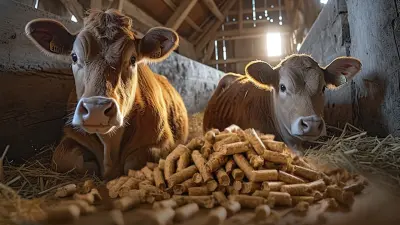
The compound feed pelletizer from TechnoMashStroy transforms loose multi-component mixtures into dense nutritious pellets with a controlled structure. In‑house pelleting lowers ration cost, stabilizes feeding quality, and accelerates the payback of farm investments. The GKM-100 and GKM-200 series cover needs from small holdings to intensive farm production.
Process essence
Pelleting includes raw material preparation (grinding to target particle size, sieving, moisture adjustment), precise formula mixing, pressing through the die, partial thermal stabilization, cooling, and short maturation before packing. In the die channels the mix is compacted; temperature and pressure destroy up to 90–95% of fungi, reduce pathogenic load, and improve sanitary safety of the ration.
Key advantages of pellets
- Uniform consumption — animals do not sort individual components, receiving a balanced profile of protein, energy, and minerals.
- Reduced dusting and transport losses — less waste, easier dosing.
- Increased bulk density — the same volume holds 2.5–3 times more nutrients versus loose mixes.
- Improved feed conversion — digestibility often rises by 5–12% due to starch gelatinization and amino acid stabilization.
- Longer shelf life with moisture controlled at 8–12% and proper packaging.
- Flexible formulation — rapid adjustments for age, breed, and productivity phase (starter, grower, finisher, lactation).
- Sanitary safety — reduced microbial and fungal load, lower risk of toxicosis.
Economics and payback
If the market price of finished pellets is about 5.5 грн/kg while the cost of your own mix after ingredient accounting is 2.5 грн/kg, the saving is 3 грн per kilogram. At a daily consumption of 10 kg the saving reaches 30 грн per day; over half a year about 5400 грн, comparable to the base price of an entry pelletizer. At 50–100 kg/day payback of the equipment shrinks to 3–6 weeks. Additional margin forms when selling surplus to nearby farms or local retail points.
GKM-100 and GKM-200 models
GKM-100 — a compact solution for small and developing farms: simple pressure adjustment, quick die change for pellet diameters for poultry, rabbits, piglets. An energy-efficient drive lowers operating costs.
GKM-200 — a reinforced model for medium and growing volumes: stable feed, increased roller life, option to integrate pre-conditioning (moist heat or steam) to improve pellet structure and nutritional value. Ideal for assortment expansion and transition to semi-commercial feed production.
Technical features
- Optimized pressing force — reduces overheating, preserves vitamin profile.
- Reinforced bearing assemblies — reduced wear in continuous cycles.
- Easy cleaning of working zones — minimizes downtime between batches.
- Flexible die range — diameter adaptation (e.g. 2–4 mm for chicks, 4–6 mm for pigs, 6–8 mm for cattle).
- Service support — recipe consulting, component selection, energy saving recommendations.
Raw materials and formulation
Base matrix includes: energy (corn, wheat, barley), protein (soy meal, sunflower meal, legumes), fiber (bran, grass meal), fats (vegetable oils for energy density), mineral block (phosphate, salt), vitamin premixes and enzymes, organic acids to stabilize gut profile. Mix moisture is raised to a technological 14–16% for plasticity, then after cooling returns to a safe 11–12%.
Mini-line based on the pelletizer
Structure: grinding — precise weighing — mixing — conditioning (if needed) — pressing — cooling — screening (fines removal) — packing. Modularity lets you start with a core (mixer + pelletizer) and gradually add auxiliary units.
Business potential
Local production of specialized pellets for regional needs (broilers, layers, rabbits, quail, piglets, high-yielding cows) forms a competitive edge thanks to freshness and transparent composition. Line expansion: functional additives (probiotics, enzymes, organic acids), seasonal formulas (anti-stress for hot periods, high-energy winter). Quality pellets reduce returns and strengthen supplier reputation.
Operating tips
- Input mix moisture control — prevents crumbling and over-compaction.
- Uniform feed rate — lowers load peaks, saves roller and die resources.
- Periodic inspection of pressing surfaces — timely replacement reduces energy use.
- Parameter log (moisture, temperature, throughput) — basis for optimization.
- Cooling before packing — prevents condensation and microbial growth in packaging.
Why choose TechnoMashStroy
The buyer receives a complete package: reliable pelletizer, technological consulting, recipe adaptation, access to interchangeable dies, and service support. GKM-100 and GKM-200 create a scalable platform: start at low volumes with later growth without full infrastructure replacement.
Implementation result
Reduced ration cost, higher biosecurity, accelerated weight gain, predictable expenses, additional income via commercialization of surplus. Proper pelleting is a strategic tool for sustainable farm development.
Conclusion
Investing in a TechnoMashStroy compound feed pelletizer pays back quickly thanks to margin between raw materials and market pellet price, stabilizes feeding quality, and opens the way to assortment expansion. Manufacturer technological support speeds launch, lowers error risk, and increases final profitability.