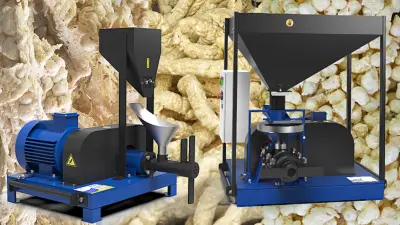
The most popular type of equipment for feed production is the screw extruder, so we will focus on it. The extruder is equipped with a screw that moves the grain along the body. As a result of this process, the raw material is subjected to pressure, heated to a temperature of 180˚C, and acquires the necessary consistency and uniformity.
History of Extruders
Before giving a clear definition of the equipment and answering the question "What is an extruder?", let’s talk about the origin of the idea. One hundred years ago, farmers from America, Germany, and England were looking for a machine that would disinfect grain, making it as useful and easily digestible as possible. The first idea of the extruder appeared back in 1930, but its purpose was different: to cover electrical wires with insulation. The machine was used to soften the material and give it a certain shape. The raw material underwent thermal treatment, and later the idea arose to use the extruder in agriculture, where grain is constantly affected by fungi and eaten by insects. Since 1959, the feed extruder has been successfully used in the agro-industrial sector.
Structure of the Extruder
All feed extruders consist of the following elements:
- body;
- working unit (screw, piston, or disk);
- raw material feeding unit;
- drive;
- additional elements for shaping the mass;
- control and measuring devices.
The most common type of such equipment is the screw extruder. It is equipped with a screw that moves the grain along the body. During the process, the raw material is subjected to pressure, heated to 180˚C, and becomes homogeneous.
The production of extruders has become widely popular. The equipment is used both in the food and light industries — almost every company finds a use for extruders.
Grain Extruder: Advantages and Possibilities
Grain extruders are especially in demand among farmers, entrepreneurs, and gardeners, as the equipment solves many problems:
- Disinfection of grain spoiled by fungi and insects.
- Production of feed that is 90% digestible by animals.
- Production of universal feed for all types of domestic animals.
- Elimination of problems with feed overuse and storage.
- Reduction of raw material purchase costs.
The design of the grain extruder makes it possible to load grain of various fractions and hardness: millet, wheat, corn (cob kernels), hay, rye, oats, etc.
The grain undergoes short-term thermal treatment at 110–180˚C, during which all pathogenic microorganisms are destroyed. Under the influence of heat and pressure (about 50 atm), an "explosion" occurs, resulting in the raw material foaming. At the output, it cools down, and the foamed mass solidifies in a shape that can be set using special nozzles with holes.
Efficiency and Statistics of Extruder Use
The use of an extruder for feed production provides the following benefits:
- The resulting extruded feed is digested by animals by 90–95%.
- The risk of gastrointestinal diseases in animals decreases by 1.5–2 times.
- Productivity (milk yield, poultry egg production) increases by 20–40%.
- The feed extruder allows you to reduce raw material purchase costs by 30–40%.
- Production of compound feed with a specific composition allows you to start your own small business and sell surplus raw materials to other entrepreneurs.
Feed extruders are suitable for different animals and birds: cows, horses, goats, sheep, rabbits, chickens, geese, ducks, turkeys. The equipment is also in demand on non-standard farms: ostrich, fish, fur farms. Manufacturers equip the units with additional nozzles of various diameters — the farmer can change the matrix and produce feed for other animals.
Chemical Changes During Extrusion
- Starch breaks down into simple sugars;
- Vitamins and amino acids are absorbed by 90%;
- Husks and coarse fibers of cereals in extruded form are completely digested by the animal's body, which improves the functioning of the digestive tract.
How to Choose an Extruder for a Small Business or Homestead?
If you have a small business or a country plot with several types of animals, there is no need to buy bulky equipment. A mini-extruder, which is easy to place in a utility room or garage and does not require special skills to operate, will suit you.
A universal option is granulating extruders: thanks to interchangeable working units, such devices allow the production of both granulated and extruded feed.